How Does the Car Paint Colour Matching Process Work in Panel Shops?
The most common complaint after a panel repair is not the workmanship, it is the colour. A panel that sits slightly off, catches the light differently, or looks newer than everything around it is the result of a broken car paint colour matching process, and it happens more often than it should.
Knowing how professional panel beaters Mandurah use to get the colour right and where cheaper shops cut corners means you can ask the right questions before your car goes in, not after it comes out.
Why Car Paint Colour Matching Is Harder Than It Looks?
Every vehicle has a manufacturer’s paint code, a reference that identifies the colour applied at the factory. That code is the starting point for any repair, but relying on it alone is one of the most common reasons colour matches fail.
Automotive paint changes from the moment it leaves the factory floor. UV exposure, heat cycles, and regular washing gradually shift the tone, saturation, and depth of every panel on your car. A fresh batch of paint mixed to the original factory code will look noticeably brighter or more saturated than the surrounding aged panels, technically correct to the code, visually wrong on the car.
This is paint fade variance, and managing it is where the automotive paint matching process gets genuinely technical.
There is also manufacturing variance. Even within the same production run, two cars carrying the same colour code can differ slightly in metallic flake distribution or base tone. A professional shop accounts for both sources of variation before mixing a single drop of paint.
How the Car Paint Colour Matching Process Works Step by Step?
Here is exactly how car paint colour matching works at a properly equipped panel shop from the moment your car arrives to the moment the oven shuts off.
- Spectrophotometer Reading
A spectrophotometer is a handheld device that measures the precise light reflectance of your existing paint at multiple angles. It captures pigment density, metallic flake orientation, and how the colour shifts under different light conditions, data that no human eye can reliably assess. This reading feeds directly into the colour mixing software and gives the technician a real-world baseline, not a factory assumption.
- Formula retrieval and adjustment
The software matches the spectrophotometer data against a database of thousands of formulas and retrieves the closest match. The technician then adjusts the formula to reflect your vehicle’s actual fade level. A three-year-old car in Mandurah’s UV-heavy climate needs a different formula than the same model fresh off the lot, and the adjustment happens before anything is mixed.
- Test spray on a panel card
The adjusted formula is sprayed onto a test card and compared against your car under multiple light sources: natural daylight, fluorescent workshop lighting, and artificial evening light. A colour that matches under one light source but diverges under another is called a metamerism failure. Catching it at the test card stage costs nothing. Catching it after the paint is on your car costs a full respray.
- Panel shop paint colour blending
Even with a precise formula, a hard edge where the repaired panel meets the original paint can be visible on any vehicle with aged surrounding panels. Panel shop paint colour blending feathers the new paint outward into neighbouring panels, graduating the transition so no line exists. On metallics and pearls, it is almost always required. On a fresh solid-colour vehicle, it may not be. An experienced painter makes that call based on the specific vehicle, not a blanket policy.
- Clear coat application and oven cure
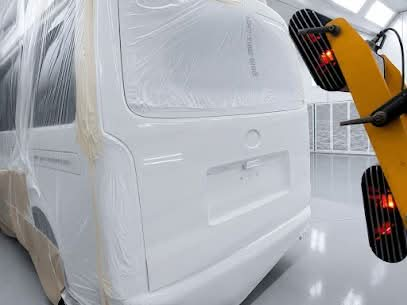
Once the colour coat is applied and blended, a clear coat is laid over the repair area. The vehicle goes into a downdraft baking oven, which cures the paint at a controlled temperature. Oven curing is not a luxury, it produces a harder finish, a deeper gloss, and significantly better resistance to chipping and UV degradation than air-dried paint. It also eliminates the dust contamination risk that comes with leaving wet paint exposed during a slow air-dry.
Why Colour Matches Fail at Some Shops and Not Others?
The gap between a match that disappears and one you can spot from three metres is almost always equipment and process. Here is where corners get cut.
- No spectrophotometer reading: A shop relying on the manufacturer code and the naked eye will produce a mismatch on any vehicle with measurable paint fade. The repaired panel looks newer and brighter than everything around it, and there is no fix short of repainting.
- No test spray: Mixing directly to the car without a test card removes the only checkpoint for catching formula errors before they are irreversible. Any correction means stripping and starting again.
- No blending: Painting only to the panel edge and stopping leaves a visible hard line on most vehicles. It is the fastest and cheapest way to complete a spray job, and it shows.
- Air drying: Air-dried paint takes longer to harden, is softer when it does, and fades faster. It is also more vulnerable to contamination during the cure period. An oven-cured finish and an air-dried finish are not comparable products.
If your repair is being funded through your insurer, these standards are not optional extras; they are what you are entitled to. The Insurance Council of Australia confirms that insurers must restore a vehicle to pre-accident condition, which includes a correct colour match. Understanding what your car insurance repair coverage should include before the repair starts protects you from accepting a substandard result.
What to Check When You Collect Your Car?
Do not inspect the repair under the workshop’s fluorescent lighting. Walk the car outside into direct natural light before you sign anything.
Check the repaired panel against the adjacent panels at multiple viewing angles. Metallics and pearls shift colour as you move around the car; the match should hold through the full range, not just face-on. Then run your eye along the blend edge. There should be no visible line, no drop in gloss level, and no texture change between new and original paint.
Check the clear coat. It should be consistent in sheen across the entire repaired area, with no dull patches, orange peel texture, or areas where it appears thinner than the rest of the panel.
If anything looks off, raise it before you leave. Once you drive away, resolving a match issue as part of the original repair becomes a much harder conversation. A workshop that stands behind its colour work will not hesitate to look at it with you under natural light before handover.
Bottom Line
A colour match that holds up in direct sun, after two years of Mandurah summers, and from every angle around the car is not about paint alone; it is about the process and the equipment behind every step of it.
When that process is done properly, the repair disappears. When it is not, you will see it every time you walk to your car.
Calmack has been getting that right for Mandurah drivers since 1989. If your car needs paint work, whether it is a small scratch, a full panel repair, or an insurance job, get a free, no-obligation quote at Calmack Panel & Paint or call (08) 9581 7898.
Frequently Asked Questions
What is the car paint colour matching process used in panel shops?
A spectrophotometer reads your existing paint, the formula is adjusted for fade, a test card is sprayed for approval, then the colour is blended and oven-cured onto your vehicle.
How does a spectrophotometer improve automotive paint matching?
It measures your car’s actual current colour not just the factory code capturing fade and metallic data no human eye can reliably assess.
Why does paint sometimes not match after a panel repair?
The shop likely skipped the spectrophotometer reading, test spray, or blending step, any one of which produces a visible mismatch.
What is panel shop paint colour blending, and when is it needed?
Blending feathers and new paint into adjacent panels to eliminate hard edges. It is almost always needed on metallics, pearls, or any vehicle with paint fade.
Does insurance cover proper colour matching on a panel repair?
Yes, the Insurance Council of Australia requires insurers to restore vehicles to pre-accident condition, which includes a correct colour match.